

30 Jul B.Ed vs D.El.Ed: Which Path Leads to a Better Teaching Career?
Choosing a career is never just about selecting a course. Instead, it is about choosing the future you want to build. For many students, teaching is more than a profession. It is often the voice of an inner child wanting to be seen and creating a worthy impact on the current state of the society, transforming for the better. It allows them to shape young minds, inspire change, and contribute to society every single day.
However, one question tends to boggle them more often than they assume.

Should you pursue a B.Ed or a D.El.Ed?
At first glance, both courses appear quite similar because both prepare students for teaching careers. Yet, there resides a huge difference when in terms of eligibility, career opportunities, salary potential, and long-term growth.
Therefore, before making this crucial decision, you should understand every aspect of both the programs.
Via this blog, we have attempted to explain the complete comparison between B.Ed and D.El.Ed in a simple and practical manner. By the end, we hope that you will have a better understanding of which course aligns better with your career goals.
What is B.Ed?
Bachelor of Education, commonly known as B.Ed, is a professional two-year teacher education program designed for graduates who wish to become qualified teachers.
The course equips future educators with practical teaching methods, classroom management techniques, educational psychology, curriculum planning, assessment strategies, and communication skills.
Today, a B.Ed degree is considered one of the most respected qualifications for anyone aspiring to teach at secondary or senior secondary schools. It is indeed a very respectable profession in an Indian societal set-up.
Moreover, prestigious educational institutions increasingly prefer professionally trained teachers who possess strong academic knowledge alongside practical classroom experience.
What is D.El.Ed?
Diploma in Elementary Education (D.El.Ed) is a two-year diploma program that prepares students to teach children at the elementary level.
The curriculum focuses on child development, foundational learning, classroom activities, and teaching strategies for younger students.
Educators who wish to teach in primary schools often choose this diploma because it introduces them to early childhood education.
Although D.El.Ed serves an important purpose, its career scope remains comparatively narrow.
https://dimtcollege.com/admission-form/
B.Ed vs D.El.Ed: Understanding the Core Difference
Many students assume that both qualifications lead to identical careers.
In reality, they prepare teachers for different educational levels.
A D.El.Ed graduate primarily teaches younger children during their foundational learning years. On the other hand, a B.Ed graduate gains expertise in teaching higher classes where subject specialization becomes increasingly important.
As education continues evolving, schools seek teachers who can handle advanced subjects, technology-driven classrooms, and modern teaching methodologies.
Consequently, B.Ed graduates often receive broader opportunities across both private and government educational institutions.
Eligibility Criteria: B.Ed vs D.El.Ed
Before selecting a course, students should verify the eligibility requirements.
Eligibility for B.Ed
Students must:
- Hold a recognized bachelor’s degree.
- Meet the qualifying marks prescribed by the university.
- Complete the admission process according to CCS University rules and regulations.
- Qualify through the applicable entrance-based admission process.
- Since B.Ed builds upon graduation-level knowledge, it prepares candidates for subject-specific teaching.
Eligibility for D.El.Ed
Generally, students must:
- Complete Senior Secondary Education (10+2).
- Fulfill minimum qualifying marks.
- Follow state-specific admission guidelines.
Although the eligibility appears easier, the course naturally focuses on elementary teaching rather than specialized subjects. It is much more narrow in practice as well as restricted.
Course Curriculum Comparison
A strong curriculum creates confident teachers.
Let’s compare and break down the details of both the courses for clarity and better understanding.
Subjects Covered in B.Ed
A B.Ed program usually includes:
- Educational Psychology
- Philosophy of Education
- Teaching Methodologies
- Curriculum Development
- Classroom Management
- Assessment Techniques
- Educational Technology
- Inclusive Education
- School Internship
- Teaching Practice
- Action Research
- Communication Skills
Furthermore, students participate in practical classroom experiences that strengthen confidence before entering the profession.
Subjects Covered in D.El.Ed
The curriculum generally includes:
- Child Psychology
- Early Childhood Education
- Language Learning
- Mathematics Teaching
- Environmental Studies
- Creative Activities
- Educational Technology
- Primary Teaching Practice
The focus remains on foundational education for younger learners.
https://dimtcollege.com/admission-form/
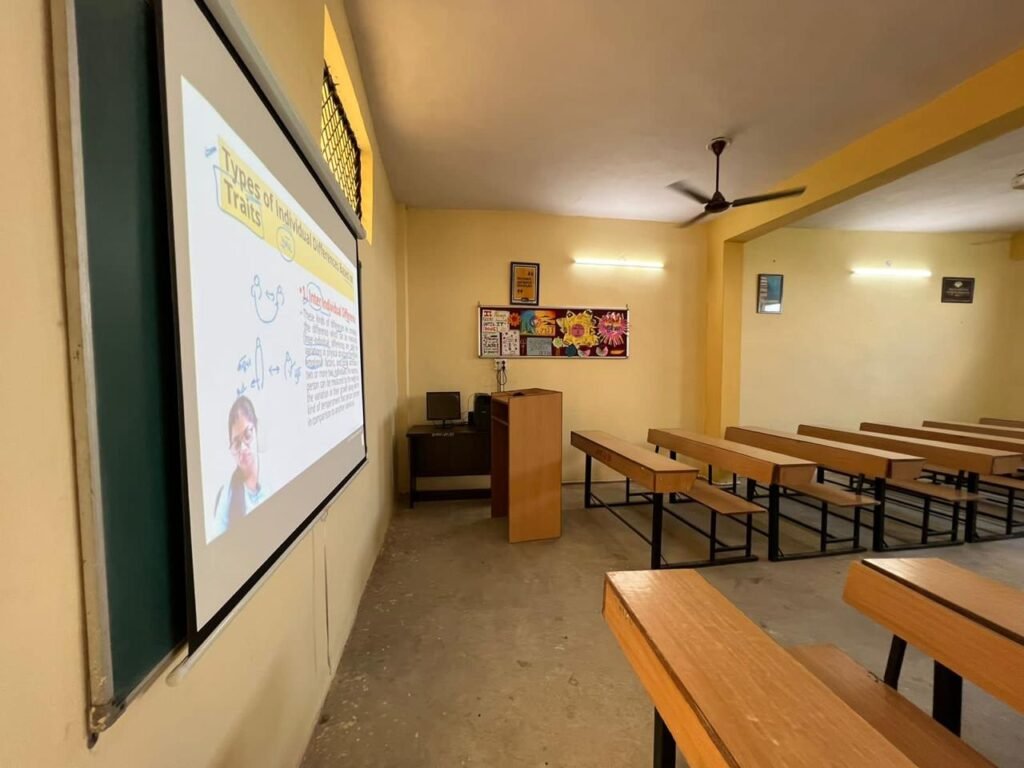
Offline Classroom Learning Makes the Difference
Teaching is not a profession that can be mastered through theory, books or merely reading material alone.
Real confidence develops inside classrooms where students interact with peers, experienced faculty, and actual learners with real-life experiences.
That is why offline classroom learning continues to play a vital role in teacher education.
Physical peer discussions improve communication skills. Classroom presentations reduce hesitation. Group projects encourage collaboration. Meanwhile, practical teaching sessions prepare future educators for real-world challenges.
These experiences simply cannot be replicated through recorded lectures or online classes.
Students also benefit from immediate faculty guidance, regular feedback, and structured academic discipline.
Therefore, our institution emphasizes upon classroom interaction that often produces teachers who feel more confident from their very first day at work with students and peers.
https://dimtcollege.com/admission-form/
Why Practical Training Matters
Imagine entering your first classroom without ever teaching a lesson.
The experience would naturally feel overwhelming, daunting and extremely challenging.
Fortunately, B.Ed programs integrate real-life experiences and teaching practice throughout the curriculum that genuinely builds upon your confidence as a future educator.
Students learn how to:
- Prepare lesson plans.
- Manage diverse classrooms.
- Handle student behavior.
- Conduct assessments.
- Build confidence while teaching.
- Improve communication skills.
- Use modern teaching aids effectively.
As a result, graduates become job-ready before completing the course.
No Comments